
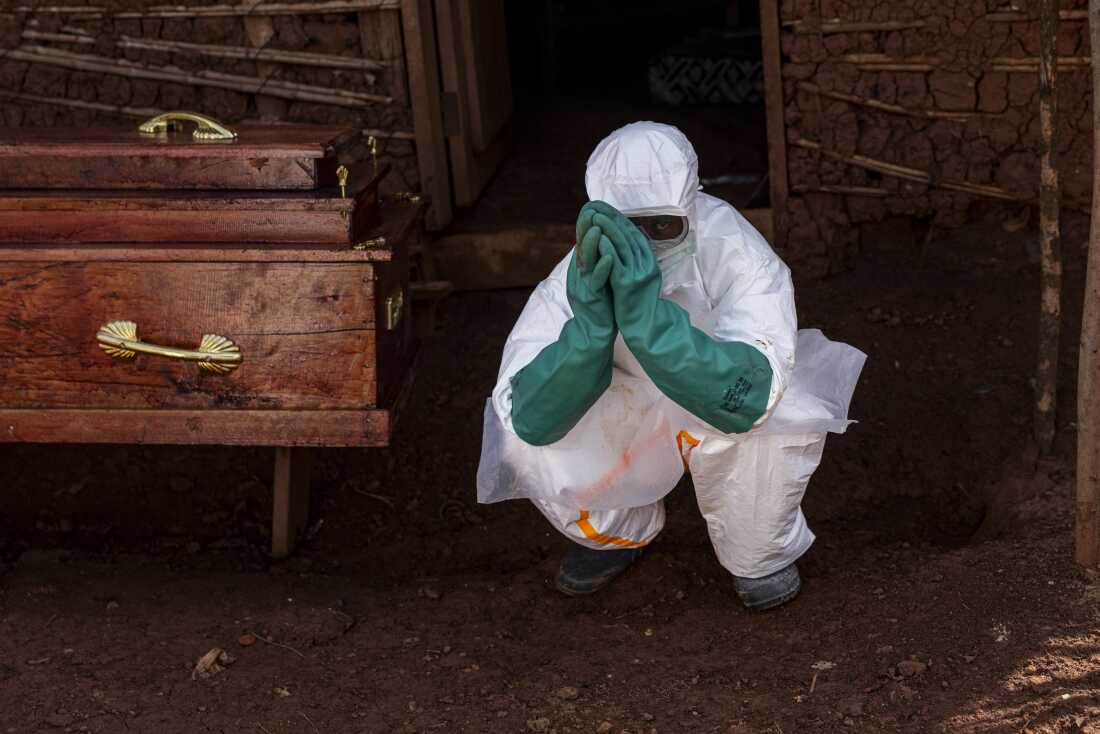
MONGBWALU, DEMOCRATIC REPUBLIC OF CONGO - MAY 24: A health worker wearing protective equipment crouches beside the coffin of a suspected Ebola victim during safe burial procedures outside a family home in the community of Mongbwaluon May 24, 2026 in Mongbwalu, Ituri Province, Democratic Republic of Congo. The World Health Organization (WHO) has declared the Ebola outbreak in the Democratic Republic of Congo (DRC) and Uganda a "public health emergency of international concern," as the death toll and number of confirmed cases continue to rise. The current epidemic is caused by the Bundibugyo virus, one of several Orthoebolaviruses that can cause Ebola disease, and for which there are no approved vaccines. The highest number of cases have been reported in Congo's eastern Ituri province, bordering Uganda. Global health officials have expressed grave concern over the capacity to contain the outbreak in a region already facing a humanitarian crisis, with highly mobile populations displaced by conflict and economic factors. (Photo by Michel Lunanga/Getty Images)

Las autoridades sanitarias internacionales continúan reforzando las medidas de vigilancia frente al incremento de casos sospechosos de ébola registrados en algunas zonas de África central.

Equipos médicos y organismos humanitarios mantienen operativos de seguimiento, aislamiento y monitoreo para evitar una expansión más amplia de la enfermedad. La preocupación se centra especialmente en regiones rurales donde el acceso a servicios médicos es limitado.

Las campañas de prevención también han sido fortalecidas para informar a las comunidades sobre los riesgos de contagio y las medidas necesarias para reducir la propagación del virus.